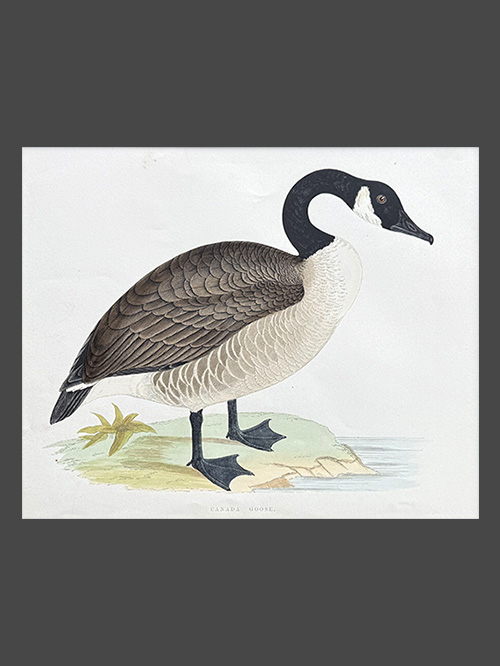
Description Original hand coloured engraving by Beverley Morris for ‘British Game Birds and Wild Fowl’ The Canada Goose (Branta canadensis) is a large, distinctive goose easily recognised by its black head and neck, striking white cheek patch, and brown-grey body plumage. It breeds across Canada, Alaska, and the northern United States, nesting near lakes, rivers, and wetlands, and winters further south in the United States, north of Mexico, and increasingly in urban parks and farmland across Europe and the UK. Its diet consists of grasses, aquatic plants, grains, and crops, and it is often seen grazing in fields or dabbling in shallow water. Highly social and migratory, it flies in loud, V-shaped formations, its honking calls a familiar sound during seasonal movements. Once declining due to hunting, the species has recovered strongly through conservation measures and managed reintroductions. However, its adaptability has led to overpopulation in some regions, where it is considered an agricultural pest and a threat to local ecosystems. Beverley Morris (1816–1883), a British naturalist and writer, was best known as the younger brother of the ornithologist Francis Orpen Morris. While less widely recognised, he nonetheless contributed to nineteenth-century ornithology through his publications. His book British Birds, With Coloured Illustrations (1851) introduced readers to species identification, habits, and distribution in an accessible form. Building upon this, his principal work, British Game Birds and Wild Fowl (1855), issued in quarto format, combined descriptive text with hand-coloured engraved plates executed by Benjamin Fawcett, one of the foremost colour printers of the Victorian period. This work concentrated on species of sporting and economic interest to mid-nineteenth-century readers, covering both game birds such as grouse and partridge, and wildfowl including ducks and geese. Beyond his ornithological writings, Morris also explored butterflies and moths, reflecting a broader passion for natural history during a time of expanding public interest. Throughout his work, he combined reliable field observation and clear description, targeting both the scientific community and general readers. Size (cms): 23(H) x 28(W) Size (inches): 9(H) x 11(W)